Why Your Strength Has Stopped Increasing: 7 Reasons Your Lifts Have Plateaued (And How to Fix It)
You have been going to the gym consistently. You complete your workouts, follow your routine, and put in the effort.
But something isn’t changing.
Your bench press is stuck at the same weight. Your dumbbell curls haven’t improved in weeks. Your squats feel just as difficult as they did a month ago.
Sound familiar?
You might be experiencing a strength plateau.
The good news is that a plateau doesn’t necessarily mean your body has stopped responding to exercise. In many cases, small adjustments to your training, recovery, and nutrition can help you make progress again.
Let’s look at seven common reasons your strength isn’t increasing and what you can do about them.
1. You’re Not Tracking Your Weights and Reps
One of the biggest mistakes people make is relying on memory instead of tracking their workouts.
If you don’t know how much you lifted last week, how will you know whether you’re improving?
Progress isn’t always about lifting heavier weights. It can also mean completing more repetitions with the same weight or performing an exercise with better control.
How to fix it:
Start recording your workouts.
For every exercise, note:
- Weight lifted
- Number of sets
- Repetitions completed
- Any changes in technique or difficulty
For example:
| Week | Dumbbell Bench Press | Reps |
|---|---|---|
| Week 1 | 15 kg | 8 |
| Week 2 | 15 kg | 9 |
| Week 3 | 15 kg | 10 |
| Week 4 | 17.5 kg | 8 |
You have made progress even though you didn’t increase the weight every week.
Remember: What gets measured becomes easier to improve.
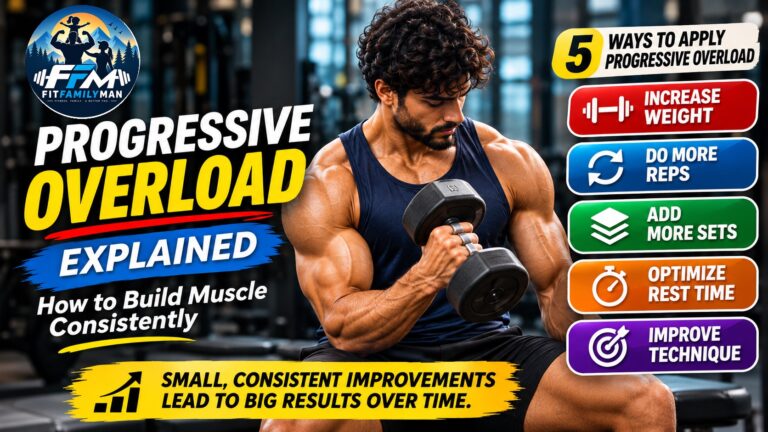
2. You’re Not Applying Progressive Overload
Your muscles adapt to the demands you place on them.
If you perform the same exercises, with the same weights, repetitions, and effort for months, your body has little reason to adapt further.
This is where progressive overload becomes important.
It means gradually increasing the demands placed on your muscles over time.
You can do this by:
- Increasing the weight.
- Performing more repetitions.
- Adding another set when appropriate.
- Improving your range of motion.
- Improving technique and control.
For example, if you can comfortably complete three sets of 10 repetitions with 10 kg dumbbells, you could aim for 11 or 12 repetitions before increasing the weight.
You don’t need to make every workout harder. Small, consistent improvements are enough.
Read next: Progressive Overload Explained: How to Build Muscle Consistently.
3. You’re Not Recovering Properly
More training doesn’t automatically mean more progress.
Your muscles need time to recover from the demands of strength training. If you’re constantly training hard without adequate recovery, your performance may suffer.
Common signs that recovery needs attention include:
- Persistent muscle soreness.
- Feeling unusually tired during workouts.
- Declining performance across multiple sessions.
- Poor motivation to train.
- Difficulty maintaining your usual training intensity.
How to fix it:
- Aim for 7–9 hours of sleep whenever possible.
- Allow sufficient recovery between demanding sessions.
- Avoid training every set to complete failure.
- Consider reducing training volume temporarily if fatigue has accumulated.
- Include rest days in your weekly routine.
Remember, training provides the stimulus. Recovery helps you adapt to it.
4. You’re Not Eating Enough to Support Your Training
You can have an excellent workout routine, but inadequate nutrition can make strength gains harder.
Your body needs sufficient energy and nutrients to support training and recovery.
Pay attention to three important areas:
Protein
Protein provides the building blocks your body uses to repair and build muscle.
For many healthy adults doing regular resistance training, approximately 1.6–2.0 grams of protein per kilogram of body weight per day is a useful target.
Carbohydrates
Carbohydrates provide energy for demanding workouts. Consistently eating too little can make it harder to maintain training performance.
Total calories
If you’re trying to build muscle and strength, an appropriate calorie intake matters.
A modest calorie surplus may help support muscle growth, although beginners and people returning to training can sometimes improve strength without one.
Practical tip: Build meals around protein sources such as eggs, chicken, fish, paneer, tofu, dal, and Greek yogurt. Include suitable carbohydrate sources such as rice, oats, potatoes, and whole grains.
5. Your Exercise Technique Needs Improvement
Lifting heavier isn’t always the answer.
Sometimes your strength appears stuck because your technique is inconsistent.
For example:
- You’re using momentum during bicep curls.
- You’re shortening your range of motion during chest presses.
- You’re rushing through repetitions.
- You’re changing your body position to move heavier weights.
These habits can make it difficult to measure genuine improvements.
How to fix it:
Prioritise:
- Controlled repetitions.
- Consistent range of motion.
- Stable body positioning.
- Appropriate exercise technique.
- Weights you can handle safely.
If increasing the weight forces you to compromise your technique, stay at the current weight until you can perform the movement properly.
Quality repetitions matter more than impressive numbers.
6. You’re Changing Your Workout Routine Too Frequently
There is nothing wrong with trying new exercises.
However, changing your entire workout routine every few weeks can make it difficult to measure progress.
Strength development requires practice. Repeating key movements allows you to improve coordination, technique, and performance.
How to fix it:
Choose a manageable set of core exercises and follow them consistently for several weeks.
Examples include:
- Squats or leg presses.
- Bench presses or chest presses.
- Rows.
- Lat pulldowns.
- Shoulder presses, if appropriate for your mobility and training needs.
- Romanian deadlifts.
You can change accessory exercises when needed, but avoid replacing every movement simply because you’re bored.
Give your training plan enough time to work.
7. You’re Trying to Progress Too Quickly
Not every workout needs a personal record.
Trying to increase your weights every single session can lead to poor technique, excessive fatigue, and unrealistic expectations.
Strength development is not a straight line.
Some weeks you’ll lift more. Other weeks you’ll repeat the same performance. Occasionally, you may even have a weaker session.
That is normal.
How to fix it:
Use a gradual progression strategy.
For example, if your target is 8–12 repetitions:
- Start with a weight you can lift for 8 controlled repetitions.
- Gradually work towards 12 repetitions.
- Once you can complete all your prescribed sets at 12 repetitions with good technique, consider increasing the weight slightly.
- Return to around 8–10 repetitions with the new weight.
- Repeat the process.
This approach is often called double progression.
It gives you a measurable way to improve without forcing weight increases before you’re ready.
When Should You Consider a Deload?
If you’ve been training hard for several weeks and your performance is declining, a short period of reduced training volume may help.
A deload generally involves temporarily reducing the amount of work you do, sometimes by reducing sets, weights, or both.
It isn’t mandatory on a fixed schedule. Consider it when accumulated fatigue is affecting your performance and recovery.
If pain rather than ordinary training fatigue is stopping you from progressing, don’t simply train through it. Adjust the exercise and seek appropriate professional advice.
A Simple Weekly Progress Tracking Method
You don’t need complicated software to monitor your progress.
Use a notebook or spreadsheet and record your main exercises.
| Exercise | Previous Workout | Next Target |
|---|---|---|
| Bench Press | 40 kg × 8 | 40 kg × 9 |
| Lat Pulldown | 35 kg × 10 | 35 kg × 11 |
| Leg Press | 100 kg × 10 | 100 kg × 11 |
| Dumbbell Curl | 10 kg × 10 | 10 kg × 11 |
These are illustrative numbers. Choose weights and repetition targets that suit your current ability.
Review your performance every 4–6 weeks rather than judging progress based on one workout.
Final Thoughts: Consistency Beats Constantly Chasing Heavier Weights
A strength plateau can be frustrating, but it is also an opportunity to evaluate your training.
Before changing your entire workout routine, ask yourself:
- Am I tracking my lifts and repetitions?
- Am I applying progressive overload?
- Am I eating enough protein and energy?
- Am I sleeping and recovering properly?
- Is my exercise technique consistent?
- Am I giving my training programme enough time?
You don’t need a new workout every month or a personal record every week.
You need a sensible training plan, gradual progression, adequate recovery, and consistency.
Remember: The goal isn’t to lift heavier every day. It’s to become stronger over time.
Keep showing up. Track your progress. Make small improvements.
A stronger you is built one workout at a time.
FitFamilyMan — Fitness. Family. A Better You.