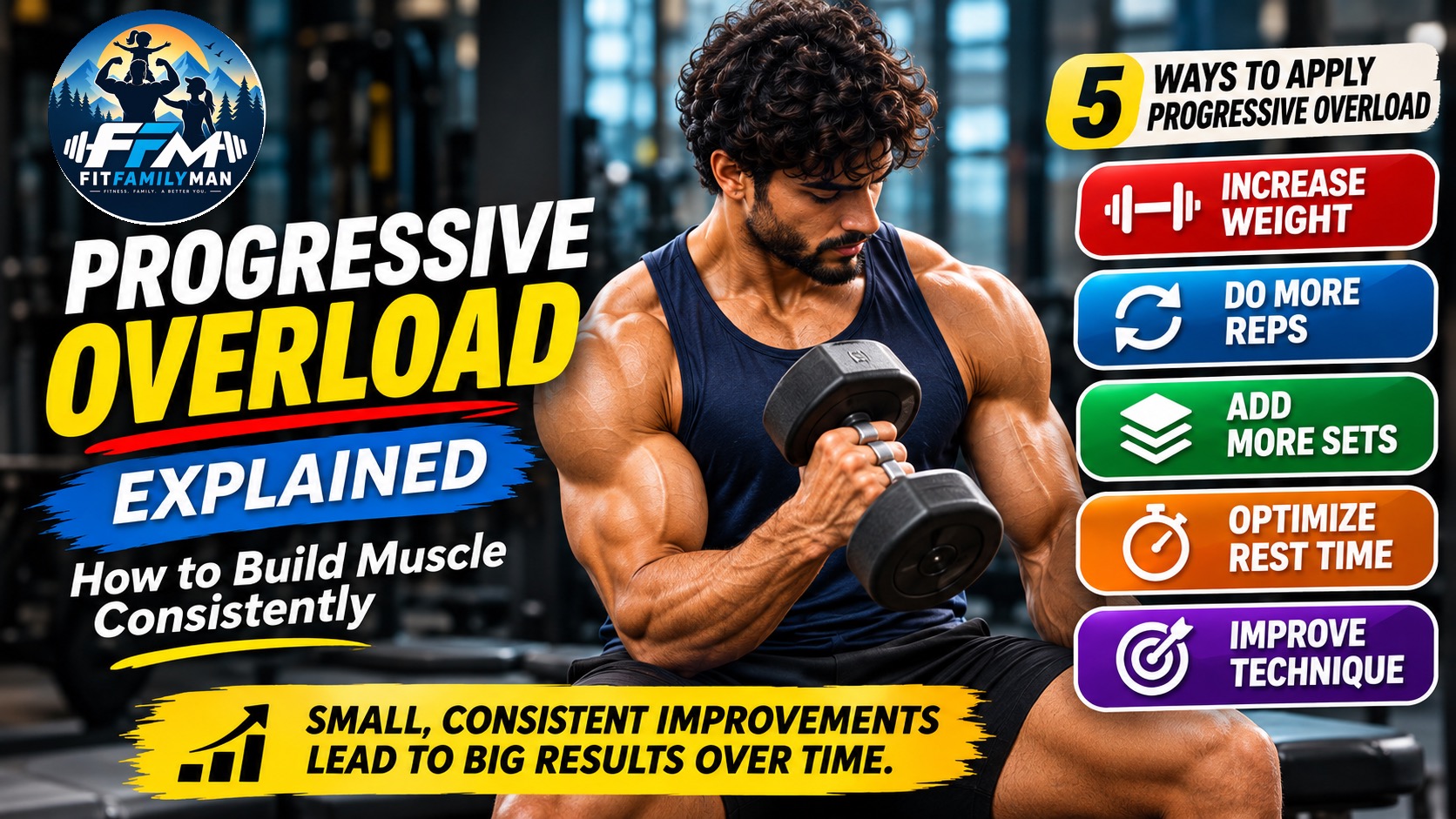
Progressive Overload Explained: How to Build Muscle Consistently
If you’ve been working out consistently but aren’t seeing the muscle growth or strength improvements you expected, there’s a good chance you’re missing one important training principle: progressive overload.
You don’t necessarily need a more complicated workout routine, expensive supplements, or hours in the gym. What you need is a way to gradually challenge your muscles so your body has a reason to adapt and become stronger.
That’s exactly what progressive overload does.
Whether you’re a beginner picking up dumbbells for the first time or someone who has been training for years, understanding this principle can make a significant difference to your results.
Let’s break it down.
What Is Progressive Overload?
Progressive overload is the gradual increase of demands placed on your muscles over time.
When you repeatedly challenge your muscles with resistance training, your body adapts to handle that workload. To continue making progress, you gradually increase the challenge.
For example:
- Week 1: Dumbbell curls — 10 kg × 8 reps
- Week 2: Dumbbell curls — 10 kg × 10 reps
- Week 3: Dumbbell curls — 12 kg × 8 reps
- Week 4: Dumbbell curls — 12 kg × 10 reps
You’re gradually increasing the work your muscles perform.
The goal isn’t to lift the heaviest weight possible every time you enter the gym. It’s to improve your performance over time while maintaining proper technique.
Remember: Small, consistent improvements lead to meaningful long-term progress.
Why Is Progressive Overload Important for Muscle Growth?
Your muscles need a reason to adapt.
If you perform the same exercises with the same weight, repetitions, and effort indefinitely, your body eventually becomes accustomed to that workload.
Progressive overload helps you:
- Build muscle by gradually increasing training demands.
- Improve strength and exercise performance.
- Avoid getting stuck at the same weights and repetitions.
- Make your workouts measurable rather than random.
- Develop consistency and confidence in the gym.
It also gives you a clear way to measure whether your training is moving in the right direction.
5 Ways to Apply Progressive Overload
You don’t always need to lift heavier weights to make progress. There are several ways to gradually increase the challenge of your workouts.
1. Increase the Weight
This is probably the most familiar method.
Once you can comfortably complete your target repetitions with good technique, consider increasing the weight slightly.
For example:
- Week 1: Bench press — 40 kg × 8 reps
- Week 2: Bench press — 40 kg × 10 reps
- Week 3: Bench press — 42.5 kg × 8 reps
A small increase is enough. You don’t need to make dramatic jumps.
For many exercises, an increase of around 2.5–5% can be a reasonable starting point, depending on the exercise and available equipment.
2. Perform More Repetitions
You can also challenge your muscles by performing more repetitions with the same weight.
For example:
- Session 1: 10 kg dumbbell curls × 8 reps
- Session 2: 10 kg dumbbell curls × 9 reps
- Session 3: 10 kg dumbbell curls × 10 reps
- Session 4: 10 kg dumbbell curls × 12 reps
Once you can complete the upper end of your target repetition range with good technique, consider increasing the weight and starting again at the lower end.
This approach is particularly useful for beginners.
3. Add More Sets
Another option is to gradually increase the number of working sets.
For example:
- Starting point: 3 sets of squats
- Later: 4 sets of squats
An additional set increases your training volume.
However, more sets aren’t automatically better. Your muscles also need sufficient recovery. Increase volume gradually and only when your current workload is manageable.
4. Improve Your Technique and Range of Motion
Progress isn’t always about adding weight or repetitions.
Performing an exercise with better control, improved stability, and an appropriate range of motion can make your training more effective.
For example, instead of rushing through dumbbell curls, focus on:
- Controlling the lowering phase.
- Avoiding unnecessary body movement.
- Using a comfortable, appropriate range of motion.
- Maintaining consistent technique across repetitions.
Don’t sacrifice proper movement just to lift heavier.
5. Adjust Your Rest Periods Carefully
Rest periods influence how much work you can perform during a workout.
However, shorter rest periods aren’t automatically a sign of progressive overload.
If you’re training for muscle growth, you should rest long enough to perform your next set with good technique and sufficient effort.
For example, you might gradually improve your workout efficiency while maintaining similar performance.
Don’t reduce rest periods simply to make an exercise feel harder. Your priority should be quality training and measurable progression.
What Does Progressive Overload Look Like in Real Life?
Let’s take the dumbbell bench press as an example.
Suppose you’re currently performing three sets of eight repetitions using 15 kg dumbbells.
Your target is to reach three sets of twelve repetitions with the same weight.
Your progression might look like this:
| Workout | Weight | Repetitions |
|---|---|---|
| 1 | 15 kg | 8, 8, 8 |
| 2 | 15 kg | 9, 8, 8 |
| 3 | 15 kg | 9, 9, 8 |
| 4 | 15 kg | 10, 9, 9 |
| 5 | 15 kg | 10, 10, 10 |
| 6 | 15 kg | 12, 11, 10 |
| 7 | 15 kg | 12, 12, 12 |
| 8 | 16 kg | 8, 8, 8 |
This is an example of double progression.
You first increase repetitions while keeping the weight constant. Once you reach your target repetitions across all sets, you increase the weight and build your repetitions again.
You don’t have to follow this exact timeline. Some exercises and muscle groups will progress faster than others.
How to Track Your Progressive Overload
If you don’t track your workouts, it becomes difficult to know whether you’re improving.
You don’t need an expensive fitness application. A simple notebook or spreadsheet is enough.
Record these five things:
- Exercise name.
- Weight used.
- Number of sets.
- Repetitions completed.
- How challenging the final set felt.
For example:
Exercise: Dumbbell Shoulder Press
Weight: 12 kg
Sets: 3
Reps: 10, 10, 9
Effort: Challenging, but technique remained controlled.
The next time you perform the exercise, aim for a small improvement when you’re ready.
Keep in mind that progress isn’t perfectly linear. Some workouts will feel stronger than others. A difficult session doesn’t mean you’ve lost your progress.
How Often Should You Increase Weight?
There isn’t a fixed schedule for increasing weights.
You don’t have to increase the load every week. The right time depends on your current strength, exercise, technique, recovery, and training experience.
A practical approach is:
- Choose a repetition range, such as 8–12.
- Start with a weight you can control.
- Gradually increase repetitions.
- Once you can complete all sets at the top of the range with good technique, increase the weight slightly.
- Return to the lower end of the repetition range and repeat.
This allows you to progress without rushing.
Common Progressive Overload Mistakes to Avoid
Progressive overload works best when you apply it intelligently. Avoid these common mistakes.
1. Increasing weight too quickly
Lifting heavier before you’re ready can compromise technique and increase injury risk.
2. Sacrificing form for more repetitions
Ten controlled repetitions are generally more useful than ten rushed repetitions with poor technique.
3. Changing too many variables at once
Don’t increase weight, sets, repetitions, and training frequency all at the same time. Make manageable adjustments so you can identify what is working.
4. Ignoring recovery
Muscle growth requires more than challenging workouts. Sleep, nutrition, and recovery all matter.
5. Expecting progress every session
Strength improvements take time. Your performance can fluctuate because of sleep, stress, nutrition, and fatigue.
Focus on the overall trend rather than individual workouts.
Nutrition and Recovery: The Other Half of Progress
Your workout provides the training stimulus, but nutrition and recovery help your body adapt.
If your goal is to build muscle, pay attention to the following:
Protein: Aim for approximately 1.6–2.0 grams of protein per kilogram of body weight each day as a practical target for many people who strength train.
Good options include eggs, chicken, fish, paneer, tofu, lentils, Greek yogurt, and whey protein.
Calories: If muscle growth is your priority, eating around maintenance calories or using a modest calorie surplus can support progress. A large calorie surplus isn’t necessary.
Sleep: Aim for approximately 7–9 hours of quality sleep each night.
Recovery: Allow muscles sufficient recovery between demanding sessions. Adjust your training if you’re experiencing persistent fatigue or declining performance.
Remember, you cannot out-train consistently poor nutrition and recovery.
A Simple Progressive Overload Plan for Beginners
If you’re new to strength training, start with a manageable three-day full-body routine.
| Day | Workout Focus |
|---|---|
| Monday | Full-body strength training |
| Tuesday | Rest or light activity |
| Wednesday | Full-body strength training |
| Thursday | Rest or light activity |
| Friday | Full-body strength training |
| Saturday | Walking or optional light activity |
| Sunday | Rest |
Choose exercises that cover the major movement patterns:
- Squats or leg presses
- Chest presses
- Rows
- Hip hinges
- Lat pulldowns
- Core exercises
Start with a manageable number of sets and repetitions. Track your performance and gradually improve one variable at a time.
If you’re unsure about exercise technique, seek guidance from a qualified fitness professional.
Final Thoughts: Progress Today, A Stronger You Tomorrow
Building muscle isn’t about destroying yourself in every workout or constantly chasing heavier weights.
It’s about showing up, training with purpose, improving gradually, and giving your body enough time to adapt.
Some weeks you’ll lift heavier. Other weeks you’ll complete more repetitions or simply perform an exercise with better control.
All of these can contribute to progress.
Train consistently. Track your workouts. Eat enough protein. Recover properly.
That’s the foundation of progressive overload — and one of the most effective principles for building strength and muscle over time.
Your next workout doesn’t have to be dramatically better than the last one. It just needs to move you a little closer to your goal.
Related Articles
- How to Build Muscle as a Beginner: The Complete Guide
- How Many Days a Week Should You Work Out? A Beginner’s Guide
- 10 Gym Rules Every Beginner Should Follow
- 7 High-Protein Indian Foods You Should Eat