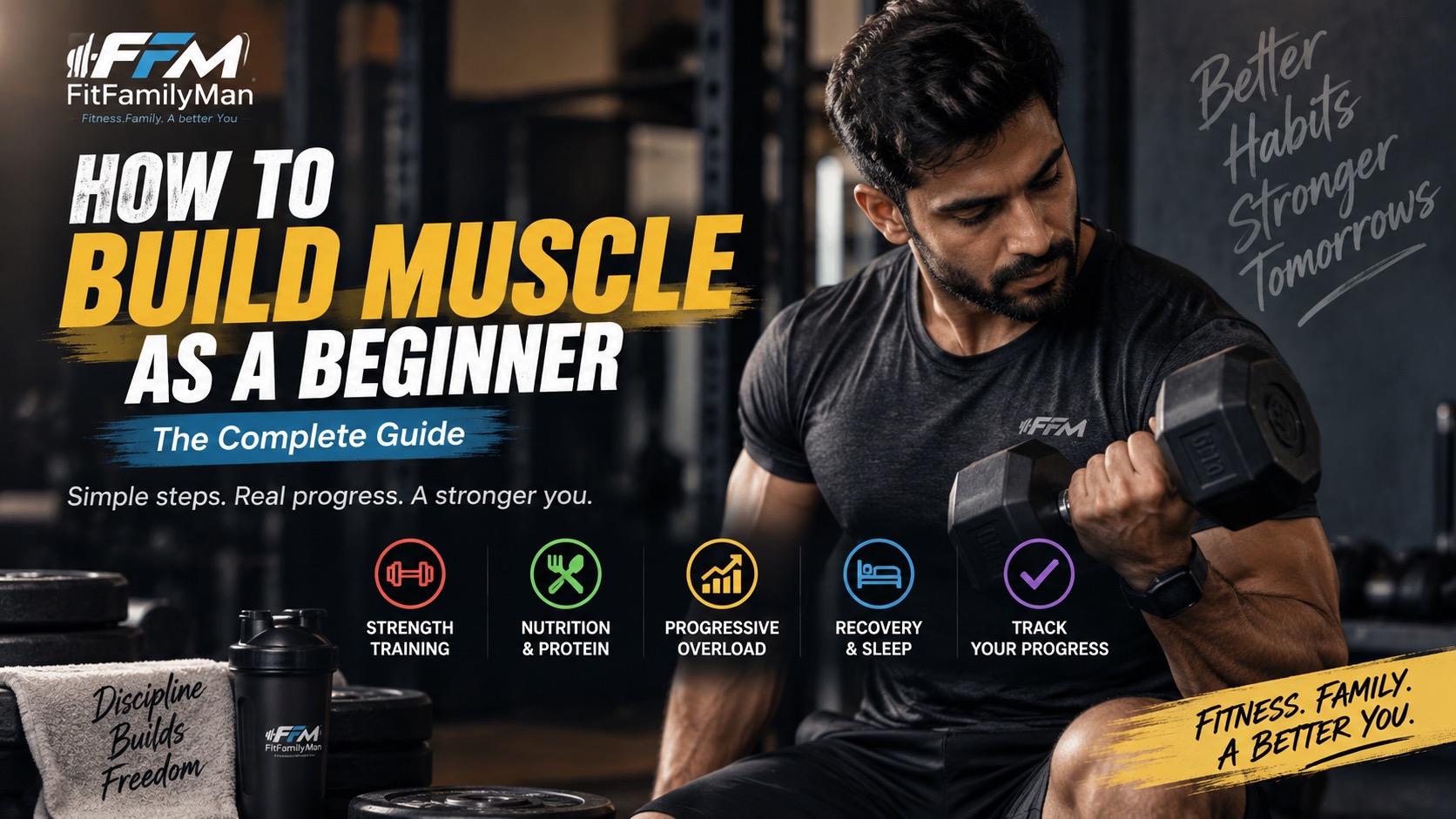
How to Build Muscle as a Beginner: The Complete Guide
Building muscle as a beginner doesn’t need to be complicated.
You don’t need a six-day workout routine, dozens of supplements, or hours in the gym every day.
What you need is a simple training plan, enough protein and calories, progressive overload, good recovery, and the consistency to follow the process long enough to see results.
The good news is that beginners often have a major advantage: your body can respond surprisingly well to resistance training when you start doing it consistently.
Whether your goal is to look stronger, improve your physique, gain healthy weight, or simply become fitter and more confident, building muscle comes down to a few fundamentals.
Here’s how to get started.
1. Start With Strength Training
If you want to build muscle, resistance training should be the foundation of your fitness routine.
When you train with weights or other forms of resistance, you create a stimulus that tells your body it needs to adapt.
Over time, your muscles become stronger and can grow.
As a beginner, you don’t need a complicated bodybuilding program.
Focus on fundamental movement patterns such as:
- Squats
- Lunges
- Hip hinges
- Bench presses
- Overhead presses
- Rows
- Pull-downs or pull-ups
- Curls
- Triceps extensions
You can perform these exercises using barbells, dumbbells, machines, cables, or even resistance bands.
The equipment matters less than consistently challenging your muscles with good technique.
2. Train 3–5 Days Per Week
You don’t need to train every day to build muscle.
For most beginners, three to five resistance-training sessions per week can work extremely well.
If you’re completely new to training, starting with three days per week is often a great option.
For example:
Monday
Full Body
Wednesday
Full Body
Friday
Full Body
This gives you regular training stimulus while allowing plenty of recovery between sessions.
As you become more experienced, you can move toward a four- or five-day routine if you enjoy training more frequently.
The best workout routine isn’t necessarily the one that looks impressive on paper.
It’s the one you can recover from and consistently follow.
3. Focus on Progressive Overload
This is one of the most important principles of muscle building.
Your body adapts to training.
If you perform the same exercises with exactly the same weight, repetitions, and effort forever, eventually your progress will slow down.
That’s where progressive overload comes in.
The basic idea is to gradually increase the training demand placed on your muscles.
You can do this by:
- Increasing the weight
- Performing more repetitions
- Adding sets
- Improving your technique
- Increasing your range of motion
- Performing repetitions with better control
For example, suppose you’re doing dumbbell bench presses:
Week 1: 10 kg × 10 reps
Week 2: 10 kg × 12 reps
Week 3: 12.5 kg × 8 reps
Week 4: 12.5 kg × 10 reps
You’re gradually increasing the amount of work you’re capable of performing.
That’s progress.
You don’t need to increase the weight every single workout. The goal is gradual improvement over weeks and months.
4. Learn Proper Exercise Technique
Don’t sacrifice technique just to lift heavier weights.
As a beginner, your first goal should be learning how to perform exercises safely and consistently.
Good technique helps you:
- Train the intended muscles
- Maintain control
- Use an appropriate range of motion
- Reduce unnecessary strain
- Track your progress more accurately
If you can perform 10 controlled repetitions with good technique, that’s generally more useful than forcing out 10 ugly repetitions with excessive weight.
Ego lifting doesn’t build muscle faster. Consistent training does.
5. Eat Enough Protein
Training provides the stimulus for muscle growth, but nutrition provides the building blocks your body needs to recover and adapt.
Protein is particularly important.
Good protein sources include:
- Eggs
- Chicken
- Fish
- Lean meat
- Greek yogurt or other suitable dairy
- Paneer
- Tofu
- Soya chunks
- Beans and lentils
- Whey or other protein supplements
A practical target for people who strength train is around 1.6–2.0 grams of protein per kilogram of body weight per day.
You don’t need to obsess over hitting an exact number every day.
Instead, make protein a consistent part of your meals.
For example:
Breakfast: Eggs + other protein source
Lunch: Chicken/paneer/soya + rice or roti
Snack: Whey protein or another protein-rich food
Dinner: Fish/chicken/paneer/tofu + vegetables + carbohydrates
Your overall diet matters much more than one particular food.
6. Don’t Be Afraid of Carbohydrates
A common beginner mistake is thinking that carbohydrates are bad for muscle building.
They’re not.
Foods such as rice, potatoes, oats, fruits, whole grains, and roti can provide valuable energy for training.
Hard training requires fuel.
If your diet is too restrictive and you’re constantly exhausted, your workouts can suffer.
Instead of eliminating carbohydrates, focus on:
- Appropriate portions
- Mostly minimally processed sources
- Enough protein
- Plenty of vegetables and fruit
- Overall calorie intake appropriate to your goal
You can build muscle while eating carbohydrates.
7. Decide Whether You Need a Calorie Surplus
If your primary goal is maximizing muscle gain, eating slightly more calories than you burn can make the process easier.
This is commonly called a calorie surplus.
However, beginners don’t always need to immediately start eating huge amounts of food.
A large surplus can result in unnecessary fat gain.
A better approach is to start with a modest increase in calories and monitor your progress.
If your:
- Strength is increasing
- Body weight is gradually increasing
- Measurements are improving
- Recovery is good
then your approach is probably working.
If you’re gaining weight extremely quickly, you may be eating more than necessary.
And if your weight, measurements, and strength aren’t moving for several weeks, you may need to adjust your food intake.
8. Don’t Change Your Workout Every Week
This is another common beginner mistake.
You find a new workout on Instagram.
Then another on YouTube.
Then another from a fitness influencer.
Before long, you’re doing a completely different routine every week.
That’s not a great way to measure progress.
Instead, choose a sensible program and stick with it for several weeks.
You want enough consistency to answer questions like:
Am I getting stronger?
Am I performing more repetitions?
Is my technique improving?
Are my muscles growing?
Without consistency, it’s difficult to know what’s actually working.
9. Give Your Muscles Time to Recover
Muscle growth doesn’t happen because you spend more hours in the gym.
Training provides the stimulus.
Recovery allows your body to adapt.
Make recovery part of your program.
That means:
- Get enough sleep
- Take rest days
- Eat enough protein
- Consume enough overall nutrition
- Manage stress
- Avoid training the same muscles excessively without recovery
Sleep is particularly important.
Aim for around 7–9 hours of sleep per night when possible.
You don’t need perfect recovery every single day.
You need reasonably good recovery consistently.
10. Track Your Progress
Don’t rely only on the mirror.
Take a few minutes every couple of weeks to track your progress.
You can record:
Body weight
Measure under similar conditions.
Strength
Record your weights and repetitions.
Measurements
Track areas such as your arms, chest, waist, and thighs.
Progress photos
Take photos under similar lighting and from similar angles.
Workout performance
Keep a simple training log.
For example:
| Exercise | Week 1 | Week 4 |
|---|---|---|
| Bench Press | 40 kg × 8 | 45 kg × 8 |
| Squat | 50 kg × 8 | 60 kg × 8 |
| Row | 35 kg × 10 | 40 kg × 10 |
Individual numbers aren’t important here.
The point is to see the trend over time.
11. Don’t Expect Results Overnight
This may be the most important lesson for beginners.
You won’t transform your body in two weeks.
Social media can make muscle building look incredibly fast because you see the highlight reel rather than the months and years of work behind it.
Instead, think in terms of months and years, not days and weeks.
Initially, you may notice:
- Better strength
- Improved coordination
- Better workout performance
- More muscle fullness
- Improved posture
- Changes in measurements
Eventually, visible changes become more noticeable.
The goal isn’t to make dramatic changes quickly.
The goal is to become slightly better than you were yesterday and consistently better over time.
12. Do You Need Supplements?
No.
Supplements can be useful, but they should come after the basics.
Your priorities should be:
1. Consistent resistance training
2. Adequate protein
3. Appropriate calorie intake
4. Good sleep and recovery
5. Progressive overload
Only then should you worry about supplements.
Protein powder can be convenient if you struggle to get enough protein from food.
Creatine monohydrate is another well-researched option that can support strength and training performance.
But you don’t need a cupboard full of supplements to build an impressive physique.
Your training, nutrition, and consistency do the heavy lifting.
13. A Simple Beginner Muscle-Building Routine
If you’re completely new to strength training, you could start with a simple full-body routine three times per week.
Workout A
Squat — 3 × 8–10
Bench Press — 3 × 8–10
Lat Pulldown — 3 × 8–12
Dumbbell Romanian Deadlift — 2 × 8–10
Dumbbell Curl — 2 × 10–12
Triceps Pushdown — 2 × 10–12
Workout B
Leg Press — 3 × 8–12
Incline Dumbbell Press — 3 × 8–12
Seated Cable Row — 3 × 8–12
Leg Curl — 2 × 10–12
Lateral Raise — 2 × 12–15
Calf Raise — 2 × 12–15
Alternate the workouts:
Week 1: A / B / A
Week 2: B / A / B
Start with manageable weights and focus on technique.
As you become stronger, gradually increase your repetitions or resistance.
The Beginner Muscle-Building Formula
If you want to keep everything simple, remember this:
Train consistently.
Give your muscles a reason to adapt.
Eat enough protein.
Give your body the raw materials for recovery and growth.
Eat appropriately for your goal.
A small calorie surplus can help maximize muscle gain.
Use progressive overload.
Gradually become stronger over time.
Recover properly.
Sleep and rest are part of the program.
Track your progress.
What gets measured is easier to improve.
Be patient.
Muscle building is a long-term process.
Final Thoughts
Building muscle as a beginner doesn’t require a complicated plan.
You don’t need to train seven days a week.
You don’t need expensive supplements.
And you definitely don’t need to copy the routine of an advanced bodybuilder.
Start with the fundamentals.
Lift consistently. Eat enough protein. Progress gradually. Recover well. Stay patient.
Do that for the next six to twelve months and you’ll be amazed at how different you can look and feel compared with where you started.
The secret isn’t finding the perfect workout.
The secret is following a good enough plan long enough for it to work.
Related FitFamilyMan article
If you’re also trying to lose body fat while improving your physique, check out our guide:
7 Fat-Loss Mistakes That Are Stopping You From Losing Weight